Keeping collage seams intact through framing, handling and shipping is one of those small victories in my studio that makes exhibitions and sales less stressful. Over the years I've repaired my share of popped corners, lifted edges and discoloured tapes — and I've developed a workflow that keeps seams secure and stable while respecting archival standards and the delicate look of collage. Below I outline the practical steps, materials and tests I use to create archival collage seams that survive framing and shipping.
Understanding the risks
Before choosing materials or techniques, I consider the hazards every piece will face: physical abrasion during handling, pressure from glass or acrylic glazing, humidity changes, and pressure and vibration in transit. Collage seams are especially vulnerable because they combine different materials (paper, fabric, paint, adhesives) with different expansion rates. That mismatch causes stress that eventually lifts or cracks seams if not anticipated.
Choose stable substrates and papers
I start by choosing archival-quality, acid-free substrates and papers wherever possible. For supports I prefer museum-board, cotton paper or heavyweight rag papers (e.g., Canson Edition, Hahnemühle). For collage elements I aim for papers with pH-neutral sizing or naturally stable fibres like cotton or linen rag. If I must use a lower-grade paper, I either back it or limit its exposure to edges and seams.
Adhesive selection: balance tack, flexibility and aging
Adhesive is the heart of a seam. Too brittle, and it cracks; too wet, and it warps; too weak, and the seam lifts. These are my go-to choices depending on the piece:
- PVA (archival, neutral pH): My everyday adhesive for paper collage. It dries flexible and strong. Brands I trust are Lineco PVA and Bookbinders' PVA. Use diluted for thin applications.
- Wheat starch paste: Traditional, reversible and excellent for thin Japanese papers or conservation-minded work. It needs a little practice but is forgiving.
- Double-sided archival tapes: Useful for hidden hinges and temporary positioning; I use them sparingly and pair with PVA for long-term security. Brands: 3M Scotch Double-Sided, Filmoplast.
- Methylcellulose: Good for temporary adhesion and working time; not the strongest final bond on its own.
Techniques for strong, invisible seams
My usual approach combines good adhesive choice with structural support. Key techniques I use:
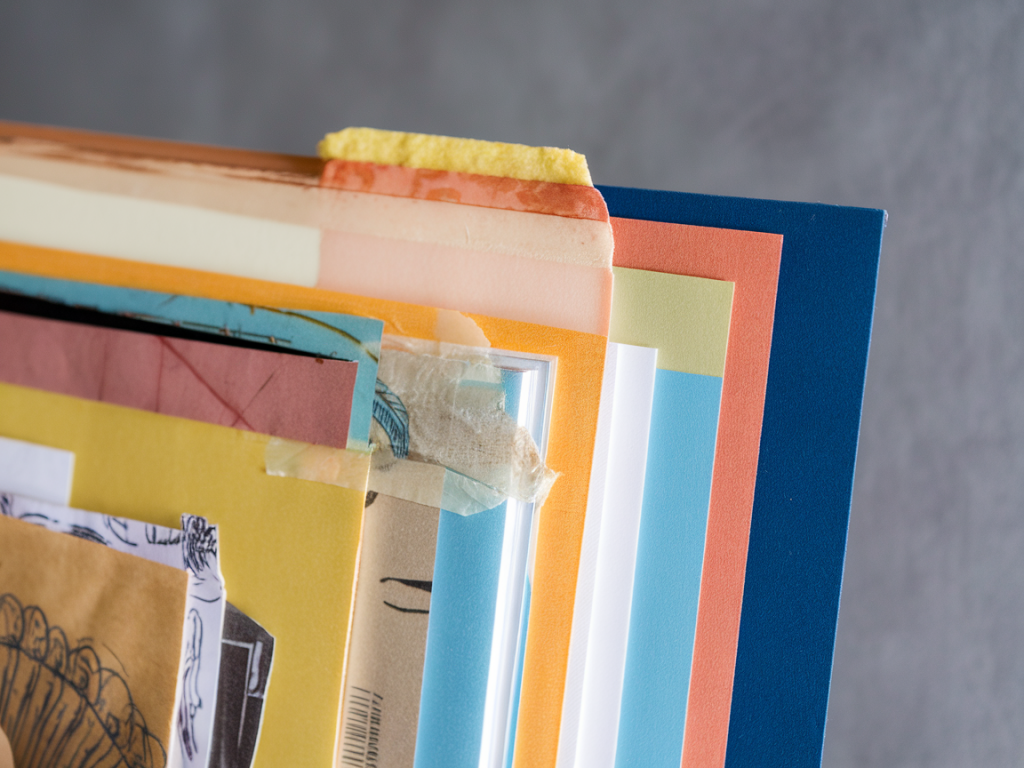
- Edge trimming and overlapping: Trim collage elements to create a slight overlap (1–3 mm) where pieces meet. This gives adhesive more surface and hides raw edges under an adjoining piece.
- Back-hinging: For delicate edges I attach a thin hinge on the back with Japanese tissue and wheat starch paste or archival PVA. A hinge keeps the front seam clean while bearing stress on the support.
- Fillet of adhesive: Where seams meet textured or painted areas I apply a very thin filament of diluted PVA into the join and smooth with a bone folder, then remove any squeeze-out. This reinforces without bulking.
- Japanese tissue reinforcement: For added strength, paste thin Japanese tissue along the seam on the back. It acts like a flexible tape that breathes and ages well.
- Heat-set adhesives (with caution): Some artists use archival heat-set adhesives for paper-on-paper seams, but I avoid them unless I’ve tested the exact papers in question because heat can change pigments and sizing.
Mounting and backing for stability
How you mount the entire collage matters as much as the seam treatment. I choose a backing that provides consistent support and, where appropriate, a barrier layer.
- Paste mounting: For exhibition works I sometimes paste-mount to a lightweight museum-board using a thin, even coat of PVA. It reduces movement and provides a firm base for seams.
- Float mounting: If I want the torn, raw edges visible, I float-mount the collage on a larger backing using hidden hinges. This avoids pressure from glazing while maintaining the visible edges.
- Interleaving: If the collage includes fragile paints or low-tack media, I add an interleaving layer (acid-free tissue or glassine) between the artwork and glazing to prevent abrasion during transport.
Matting and glazing considerations
A well-chosen mat and glazing will protect seams. I always allow a small air gap between artwork and glazing (spacers or mat depth) to prevent direct contact. For glazing I prefer museum glass or acrylic with UV protection — acrylic is safer for shipping because it won’t shatter, but it can produce static, so I use anti-static acrylic where possible.
Packing and shipping—protecting the seams in transit
Even with perfect seams, poor packing will undo your work. My packing routine is methodical:
- Wrap the piece in acid-free tissue or glassine. If the front has texture, I place a sheet of archival foamcore over the front as a rigid protector.
- Use corner supports made from chipboard or foam to protect edges and corners. Collage seams often lift at corners, so this step is crucial.
- Place the artwork between two rigid sheets (foamcore or corrugated board), then shrink-wrap lightly or secure with bands. Avoid direct adhesive tape on the artwork.
- Box with plenty of cushioning (bubble wrap, foam, crumpled kraft paper) and ensure the artwork cannot shift. I use double-walled boxes for heavier pieces.
- If humidity is a concern, include silica gel sachets in the box. Label the box with “Do not bend” and “This way up.”
Testing and record-keeping
I test any new adhesive or combination of materials before I use them on a final piece. My tests are simple:
- Create a small mock-up using the exact papers, paints and adhesives.
- Subject the mock-up to gentle bending, humidity changes and a period of time (weeks) to observe any lift, discoloration or brittleness.
- Keep a notebook of results: adhesive brand, dilution, drying time, and outcomes. This saves me repeating mistakes.
| Adhesive | Strength | Flexibility | Reversibility |
|---|---|---|---|
| Lineco PVA | High | Good | Low (solvent needed) |
| Wheat starch paste | Moderate | Good | High (washable) |
| Filmoplast tape | Moderate | Good | Moderate |
Common problems and fixes
If seams start to lift, I first assess whether the cause is ongoing (humidity, pressure) or a past failure. For localized lifting I carefully lift the loose edge, clean dried adhesive if necessary, apply a thin adhesive bead, press back with a bone folder and reinforce from the back with Japanese tissue. For larger failures I remount the affected area and add a barrier layer if moisture seems implicated.
Final practical tips I always follow
- Work on a slightly damp-proof surface — even humidity in the studio affects adhesion.
- Allow adhesives to cure fully before framing or shipping. Rushed pieces are the ones that fail in transit.
- Label the verso with materials and methods used — it helps conservators and buyers later.
- When in doubt, add a thin tissue backing: it’s lightweight, strong and conservative-friendly.
These methods let me keep the visual lightness of collage while ensuring the seams don’t betray the piece in transit or on the wall. The balance between invisible joins and durable construction is subtle, but with a few reliable materials and tests, you can build seams that survive the journey from studio to collector intact.