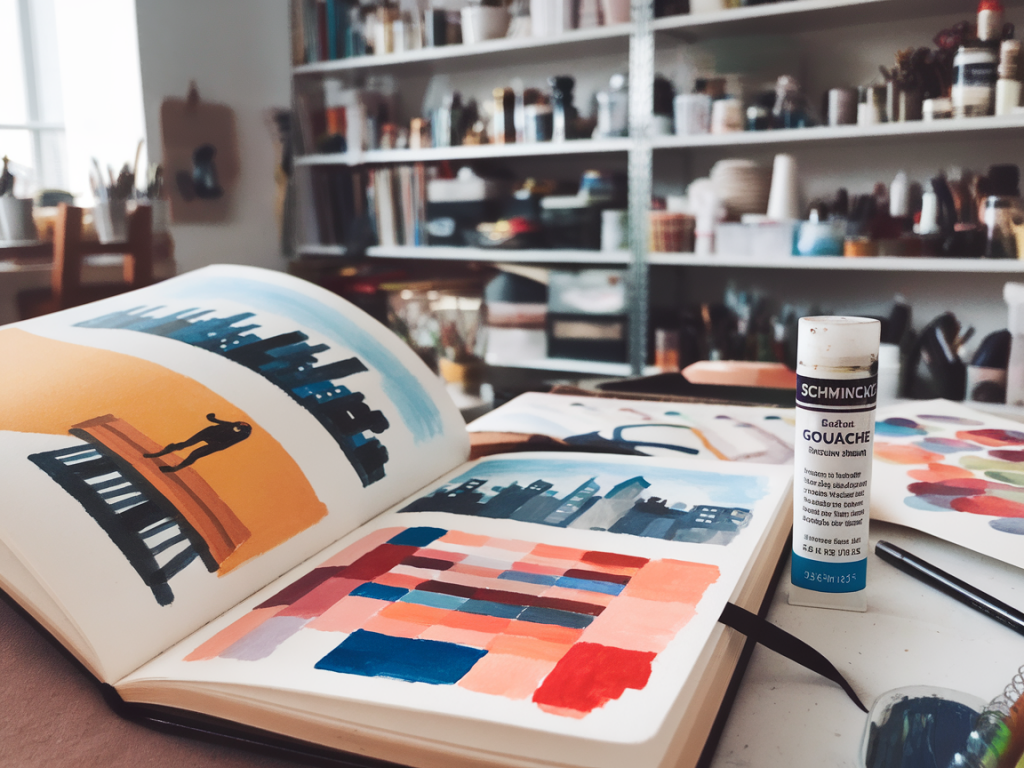
I switched to Schmincke Horadam Gouache for my studio sketching routine about nine months ago, and the change surprised me in small, practical ways — and in some bigger, more creative ones too. I’d been using a mix of Winsor & Newton Designers’ Gouache and student tubes when I wanted quick colour studies, and acrylic when I needed fast, matte blocks of colour. The move to Schmincke felt like upgrading a tool that I’d used casually into something I could rely on as part of a considered practice.
Why I made the switch
There were a few specific things that pushed me to try Schmincke. First, I wanted better pigment strength and consistency across a limited palette — something I could trust when mixing greys, glazing over layers, or establishing a quick harmony in a sketchbook page. Second, I wanted greater rewettable performance: I like to work in sketchbooks and carry a small travel palette, so paints that revive cleanly from dryness are essential.
Finally, I was curious about lightfastness. On repeated studio visits I’d been frustrated by colours that shifted over time, especially the muted oranges and delicate blues. Schmincke’s Horadam line clearly lists pigment information and lightfast ratings, which appealed to my editor brain as much as my maker’s needs.
First impressions: texture, handling and colour
The first time I squeezed Schmincke onto my palette I noticed the buttery, dense texture. The paint is thick enough to hold a mark but fairly forgiving when I add water. Compared with Winsor & Newton Designers’ Gouache (which I’d used previously) Schmincke feels silkier and slightly more luminous — not glossy, but with a reflective quality that keeps colours from looking dead-flat.
Colour-wise, the pigments feel more honest. The Ultramarine and Sap Green have a depth that made mixing shadows richer than I expected. Opacity varies across the range — some colours (like Zinc White and Naples Yellow) are more translucent — but overall the coverage is stronger. That matters when I’m sketching directly over toned paper or blocking in a background and want to keep subsequent layers clean.
How it changed my sketching process
Several practical things shifted in my studio workflow:
One delightful surprise: my quick studies now feel more finished. The combination of good opacity and subtle sheen lets a small sketch read like a resolved painting at a glance — which is useful when I share process shots on Sonriseartists or prepare images for features.
Practical notes: mixing, rewetting and drying
I keep a small tin palette with 10-to-12 half-pans of Schmincke Horadam. My go-to set-up includes:
Mixing is straightforward: fewer surprises in metamerism, and complementary mixes stay clean rather than turning muddy too quickly. Rewetting dried pans only needs a wet brush or a mist of water — pigments revive without graininess. Drying time is standard for gouache: faster than acrylics in thin layers, but slower for thick passages. I avoid heavy impastos with gouache; it’s better suited to layered transparency and opaque blocks.
Brushes, paper and tools I pair with Schmincke
My favourite brushes for gouache sketching are synthetic rounds with a good snap — they hold a point and recover their shape well after being used with rewettable paint. I’ve found that water brushes are handy for travel sketches, but for precise line work I prefer a small synthetic round and a mop brush for washes.
Paper choice matters more than ever. I use:
Lightfastness and documentation
One of my main motivations was colour longevity. Schmincke’s transparent labelling makes it easy to select pigments with good lightfast ratings. For works that I intend to include in the journal or sell, I photograph early and keep a record of pigment choices in my notes, which helps later if a client asks about materials or if I want to reproduce a sketch in print.
When Schmincke isn’t ideal
It’s not all roses. Schmincke Horadam is priced at a premium compared with student gouaches and some other designer ranges. If you’re on a tight budget, you might prefer Winsor & Newton Designers’ Gouache or Holbein; both are perfectly serviceable. Also, for thick, structural work I still choose acrylic or heavy body paints — gouache isn’t meant for buildup like acrylics or oil.
Finally, some colours are less opaque than you might expect. If you need pure flat-covering white areas, Titanium White (in acrylic) performs better than zinc or titanium in gouache. I adapt by reserving white paper for highlights and using gouache whites sparingly.
Quick comparison
| Feature | Schmincke Horadam | Winsor & Newton Designers | Holbein |
| Pigment depth | High — rich and clear | Good — slightly flatter | High — vivid |
| Rewettable performance | Excellent | Good | Very good |
| Lightfast information | Clear labelling | Reasonable | Good |
| Price | Premium | Mid-range | Mid–premium |
Tips if you want to try Schmincke for sketching
Switching to Schmincke hasn’t changed everything about my practice, but it has refined how I approach colour, layering and portability. My studio sketching feels more like an on-going conversation now: the colours are reliable, the handling is friendly, and I’ve found myself trusting quick studies more — both as finished pieces and as accurate source material for larger works.