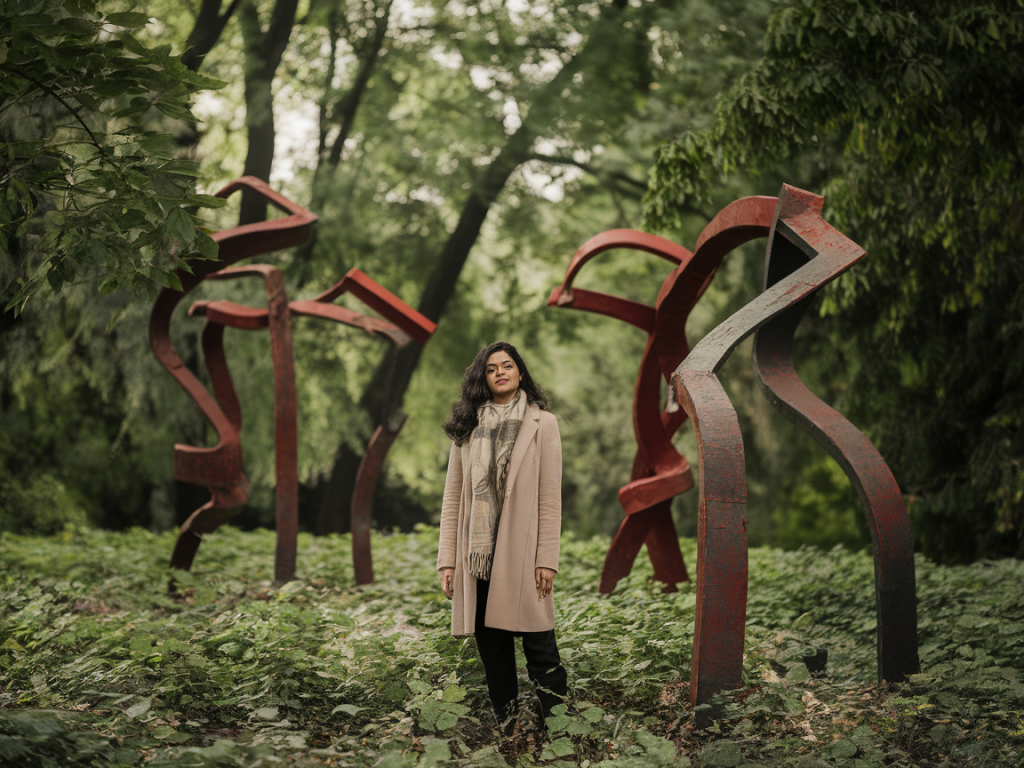
When I first saw Mara Singh’s series of abstract landscapes, I felt like I was stepping into the hush between memory and weather. There’s a particular hush in her work — layered, tactile surfaces that seem both held and dissolving, like a remembered shoreline after the tide has emptied. I invited Mara to the studio to talk through the ways she translates memory into paint, and what came out of our conversation was as much about process and materials as it was about the small, recurrent habits that shape a practice.
How memory becomes motif
Mara told me she doesn’t set out to paint a specific place. Instead, she collects fragments: a childhood walk, the arc of light through a kitchen window, a coastline seen from a train. Those fragments become the emotional scaffold of a painting. “I’m less interested in geography and more in the sensation of remembering,” she said. The resulting work reads like a topography of feeling — hills and fields are suggested by brush direction, washes and torn paper rather than drawn outlines.
I asked her how she decides which memory becomes a painting. She described a process of filtration: something small will spark a repeatable gesture in the studio — a pressure of charcoal, the drag of a palette knife through gesso — and that gesture becomes an anchor. From there she builds, allowing the painting to contradict itself. “If a part feels too literal,” she explained, “I’ll obscure it. The act of hiding is as important as the act of revealing.”
Materials and marks: what she uses and why
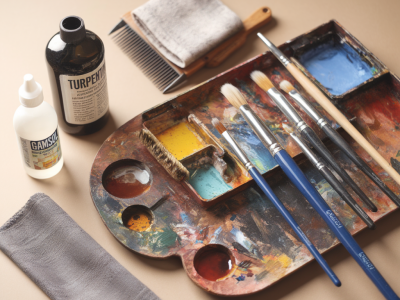
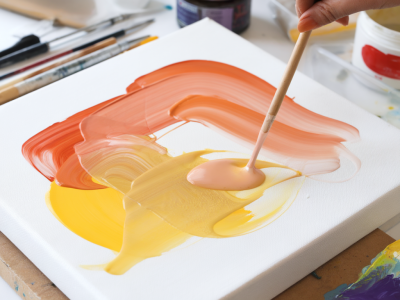
Mara’s studio table is pragmatic and particular. She favors gouache and acrylic for their immediacy and opacity, working on heavyweight paper and cradled panels. For textural work she uses PVA glue, acrylic gel medium (I watched her reach for Golden’s Heavy Gel), and layers of Italian handmade papers—soft, fibrous sheets that she tears and adheres to create ridges and recesses.
She’s not precious about brands, but she’ll insist on certain tactile qualities:
One thing that stood out in our conversation was how she uses simple household materials to alter surfaces: sand mixed with acrylic, diluted PVA to stain paper, and even kitchen paper towel soaked and pressed into a gel layer to create subtle impressions. These low-cost experiments let her rework areas without overthinking permanence — which, she said, is vital. “I need the permission to ruin a surface,” she laughed. “That risk is where interesting marks show up.”
Working rhythm: from small gestures to sustained atmosphere
Mara tends to start small. A panel no bigger than A3 will often be the testing ground for a gesture — a scraped line, a torn paper edge, a diluted stain — which she then scales up in a larger piece. She keeps a rotating pile of these studies; some become collage elements, others inform colour choices.
Her paintings breathe because of the alternation between fast and slow work. She’ll make a rapid gouache wash, walk away, and return to scrape back with a palette knife or sandpaper. That sanding is significant — it reveals underlayers, softens edges, and creates tiny ridges that catch light differently. When I watched her sand a finished area, she remarked, “It’s like erasing the loudest word from a sentence so another tone can come through.”
Color: memory as weather
Colour in Mara’s work isn’t decorative — it’s meteorological. She talks about “temperature” in the palette: the cool grey of a distant afternoon, a warm clay that signals a remembered hearth, a washed indigo that feels like a memory of rain. Her colours are often muted, layered with washes so that the surface reads as both luminous and guarded.
She mixes her own greys and neutrals rather than relying on pre-mixed tubes because those subtle nuances matter. A tip she shared that I find immediately useful: keep a small sketchbook dedicated to colour mixes. Note ratios and contexts. “When you’re trying to recapture a feeling,” she said, “having the recipe is a lifesaver.”
Compositional decisions: suggestion over description
Mara’s compositions are composed of suggestion. Rather than delineating a horizon line, she will place a horizontal band of tone, occasionally broken by a vertical scrape — a reed, a wall, an impression of a tree. These minimal devices anchor the viewer without forcing a literal read.
She emphasises negative space as an active element: the areas left undecorated work like held breath. In practical terms, this often means resisting the urge to “finish” every corner. “If something is quiet,” she told me, “it gives the rest permission to sing.” That restraint is difficult but vital — especially for makers used to filling up surfaces densely.
Studio habits and practical tips for makers
Mara’s studio habits are modest and repeatable. She keeps a palette of five mixed colours ready, rotates papers through humidifying trays to make them more pliable for collage, and always works with at least two paintings simultaneously to allow for cooling periods and fresh eyes. Here are a few practical tips she shared that I’ve tried myself:
Influences, books and music that keep her going
Mara’s influences range from Mark Rothko’s insistence on colour as emotion to the lyric restraint of British landscape painters such as Peter Lanyon. She also admires contemporary peers working with collage and paper — artists like Hannah Adamaszek and Cy Twombly’s gestural calligraphy are often on her mind. Books she recommends include Edmund de Waal’s writing on memory and craft, and Rilke for mood if you want a poetic nudge.
Music plays a role in how she sets a painting’s rhythm. She tends to put on an album that matches the imagined atmosphere of a piece — ambient music or modern classical when she wants to work slowly, and folk or lo-fi when she’s building layers quickly.
Exhibiting work and speaking about intention
Mara is thoughtful about the way she frames her work in exhibitions. She doesn’t like long wall texts that over-direct the viewer. Instead, she prefers a short note that hints at source material without pinning it down: a line of context rather than a narrative map. “I want people to bring their own memories to the paintings,” she said. That open-ended approach makes the work a space for dialogue rather than a fixed account.
When displaying, she likes space around each piece and often asks galleries to hang works at a slightly lower-than-average height so that the viewer stands in relation to the “ground” of the painting. Small, tactical choices like this change how a viewer moves through a room.
Seeing Mara at work reminded me why I love visiting studios: the way material choices, modest rituals and a committed curiosity combine to produce work that feels both intimate and generous. If you’re interested in trying some of Mara’s approaches, start small, keep a visible trail of experiments, and most importantly, allow space for erasure. Memory, after all, is as much what we choose to forget as what we remember.