I’ve spent years refining a compact mixed-media kit that fits comfortably under a café table, in a train seat pocket, or on my lap without turning a brief sketching session into a logistical puzzle. The trick isn’t just squeezing supplies into a small bag — it’s designing a system that protects fragile materials from spills, keeps inks and wet media tidy, and gives you enough variety to respond quickly to a scene.
Why a purpose-built portable kit matters
Sketching away from the studio forces decisions: you can’t carry everything, and you often have seconds to capture a light, a face, or a composition. A well-organised kit reduces friction. When I’m travelling by train or perched in a tiny café corner, I want to pick up my sketchbook and work, not untangle brushes or mop up a puddle of ink. Building a kit with spill-proof thinking and spatial efficiency lets me focus on looking and mark-making.
Choosing the right bag
Start with containment. I favour a small roll-top messenger or a cube-shaped pouch that sits upright on a table so things don’t tumble out. Waterproof or water-resistant fabrics (like coated canvas or nylon) are indispensable — accidental rain or a knocked-over coffee won’t immediately soak through. My go-to is a medium-sized zip cube inside a crossbody bag: the cube keeps supplies contained and the crossbody bag keeps my hands free.
- Size: palm-sized compartments for easy access, but big enough to hold an A5 sketchbook.
- Structure: firm base or internal sleeve to keep things upright.
- Material: water-resistant exterior and wipeable interior.
Essential items I never travel without
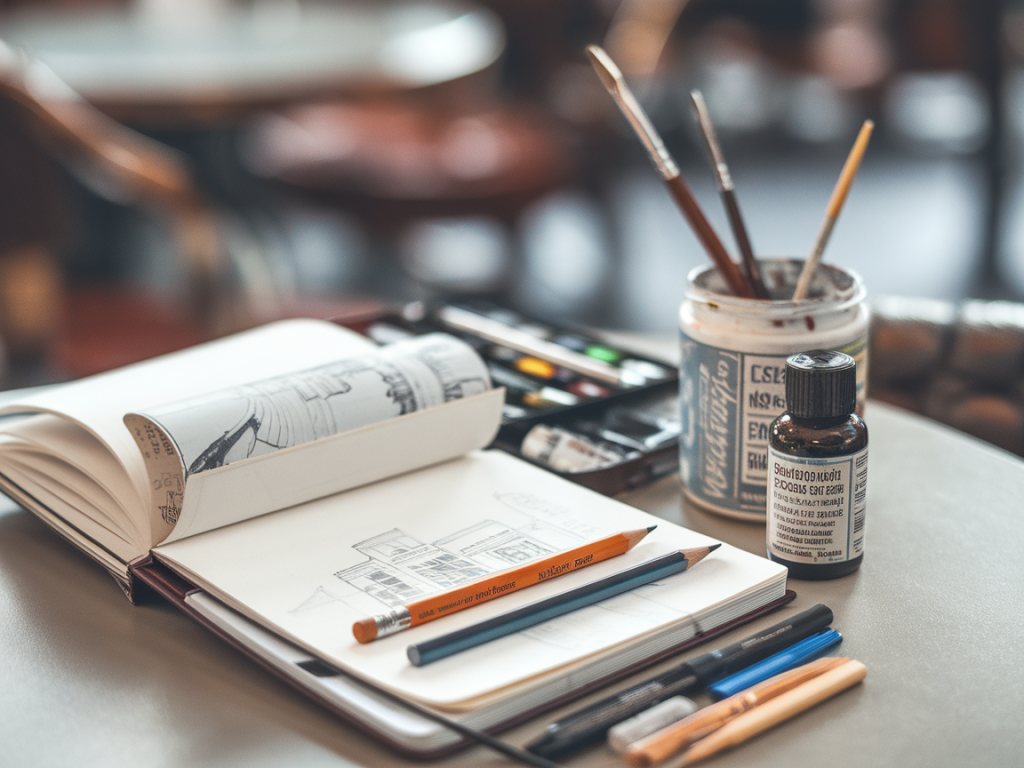
My kit balances wet and dry media so I can choose the mood of the sketch. Here are the core items I pack:
- Small A5 hardcover sketchbook (gives a firm surface and protects pages)
- Water brush (with refillable barrel) and a collapsible water cup
- Half-pan watercolour set or a pocket gouache set (I use Winsor & Newton Cotman half-pans)
- Compact folding palette or silicone mixing mat
- 1–2 pigment liners (0.1–0.5 mm) and a fountain pen with waterproof ink (I like Platinum Carbon or Sailor’s waterproof inks)
- Graphite stick or mechanical pencil
- Small stick eraser and a kneaded eraser
- Multipurpose brush (size 6–8 synthetic round) and a small mop brush for washes
- Permanent marker for bold marks and a white gel pen for highlights
- Pack of tissues, paper towel, and a small plastic bag for wet rubbish
- Microfibre cloth to protect surfaces and wipe brushes
How I prevent spills and leaks
Spills are the enemy of a portable kit. I’ve learned the hard way: a tipped water cup can ruin a sketchbook and a phone. These are my strategies:
- Use screw-top bottles: Replace open water pots with a small screw-top Nalgene or a water brush. Water brushes are my favourite because they combine brush and water and eliminate separate containers.
- Seal paint pans: Take pans that close securely or place removable pans into a small airtight tin. I sometimes stick a small square of foam between pans to stop them rattling and opening.
- Zip-lock everything wet: Put brushes, water brushes and wet tools in a zip-lock bag. If something leaks, the bag contains it.
- Double-layer protection: Wrap sketchbooks in a plastic sleeve or use a hardcover to keep pages safe from splashes.
Layout for tight spaces: how I set up in a café or on a train
Space is usually my constraint, not time. I aim for a one-handed set-up so I can hold a coffee in the other hand. My routine:
- Slip the sketchbook onto my lap or open it on the table with the spine against the armrest or window — this gives a steady surface.
- Keep a small tray (I repurpose a paperback-sized rigid board) in my bag; it acts as a table if necessary and creates a flat surface on my lap.
- Place the zip cube to the left or right (dominant hand side) and open one compartment — everything is within thumb reach.
- Use a single water brush or small collapsible cup; if using a cup, keep it on the side closest to you and away from edges.
Compact palettes and colour strategies
Space means colour choices must be deliberate. I use a small half-pan set with a mixture of warm and cool primaries (a cool and warm of red, blue and yellow), plus a neutral like Payne’s Grey. That limited palette allows me to mix a broad range of hues without overloading the kit.
For gouache I prefer a tiny tin of pre-mixed colours for quick layers and a few primary tubes squeezed into a plastic palette. If I want more vibrancy, I bring a small tube of Quinacridone Rose or Cadmium Yellow Deep — one or two high-chroma colours make a huge difference.
Tools for texture and mixed-media play
Part of the joy of sketching out and about is experimenting. I carry lightweight extras that add texture without bulk:
- Washi tape sample strip (for quick collage)
- Small glue stick or double-sided tape dots
- Chalk pastel stick or a few torn pastel scraps wrapped in paper
- Ink cartridge or tiny bottle of black India ink in a leak-proof vial
- Single-edge razor blade or craft knife in a safety cap for scratching back layers
Quick workflows I use on the move
I have a few go-to sequences that help me finish something usable in 10–30 minutes:
- 30-minute study: Pencil sketch (5–8 minutes), ink lines (5 minutes), quick watercolour wash (10–12 minutes), add gouache highlights and white pen (remaining time).
- 10–15-minute gesture: Pigment liner and water-brush wash — focusing on light and shadow, not detail.
- Layered mixed-media: Start with a collage base (washi + paper scraps), draw into it with pencil and ink, then add translucent watercolour layers.
Refilling, maintenance and smart replacements
After a day out, I clean brushes immediately with a microfibre cloth and rinse water brushes thoroughly. I top up water brushes before the next trip and replace any open pans that show signs of cracking. Keep a small spare of consumables (one extra water brush, a backup pen) in your home studio so you're never caught without essentials.
| Item | Why |
|---|---|
| A5 sketchbook | Rigid support, portable size |
| Water brush | No separate cup, leak-safe |
| Half-pan watercolours | Compact, mixable palette |
| Pigment liners & fountain pen | Line work and permanence |
| Small zip cube | Organisation and spill containment |
I’ve found that the most reliable kit is one you’ve tested on at least three different trips. Tweak items as you go — ditch what you don’t use and add what you miss. Over time you’ll develop a portable system that survives coffee spills, narrow train tables and the unpredictable joy of sketching outside of the studio.