I’m often asked how to pull together a solo show when time is short and the budget is even shorter. Over the years I’ve learned that a focused concept, a tight timeline and a few practical shortcuts will get you from first idea to hanging flush on the wall — without losing the integrity of the work. Below I share a step-by-step approach I use when planning solo exhibitions on a shoestring: pragmatic, hands-on and honest about trade-offs.
Start with a clear, buildable concept
A tight budget doesn’t mean vague ideas — it means a concept that can be realised with what you already have. Ask yourself:
- What pieces are closest to “finished” already?
- Which works can be adapted or reworked quickly?
- Is there a small, coherent story that links 8–15 pieces rather than a sprawling, expensive spectacle?
I once pulled a show together around the theme of “palimpsest” using paintings and collaged works I’d been stacking in a corner. Reworking edges, adding a few new layers and grouping them by palette created coherence without producing a lot of brand-new pieces.
Set a realistic timeline and milestones
Work backwards from your opening date and create weekly milestones. For a four- to six-week schedule I use:
- Week 1: Finalise concept, shortlist works, book venue and confirm opening date.
- Week 2–3: Finish, frame, photograph and write text for the show (statement, labels).
- Week 4: Promote the show: press release, social media, mailing list.
- Final week: Install, create price list, host preview/opening.
Breaking tasks into sprints keeps momentum. I put non-negotiable daily targets in my calendar (e.g., finish one piece, photograph three works, write 300 words of statement).
Budget essentials and where to save
Decide early what you must spend on and what you can reduce. Typical budget lines include venue hire, transport, framing/mounting, printing (catalogues, invites), promotion and hospitality for the opening.
| Item | Typical low-cost option | Estimate (£) |
|---|---|---|
| Venue | Community gallery windows, pop-up in a cafe or shared artspace | 0–200 |
| Framing/Mounting | DIY float frames, spray-mount on board, reclaimed frames | 50–300 |
| Transport & insurance | Self-transport, temporary insurance from venue | 0–150 |
| Printing & promo | Digital invites, limited risograph flyers | 20–150 |
| Opening hospitality | BYOB, homemade snacks | 20–80 |
Brands and tools that help: I use Blick or Cass Art for materials, cheap but reliable picture hanging kits from Amazon Basics, and a Fuji Instax or a smartphone with a small LED panel (Neewer) for straightforward documentation. For prints, I recommend local printers who offer student or small-batch rates, or online services like MOO for postcards.
Framing, presentation and low-cost mounting techniques
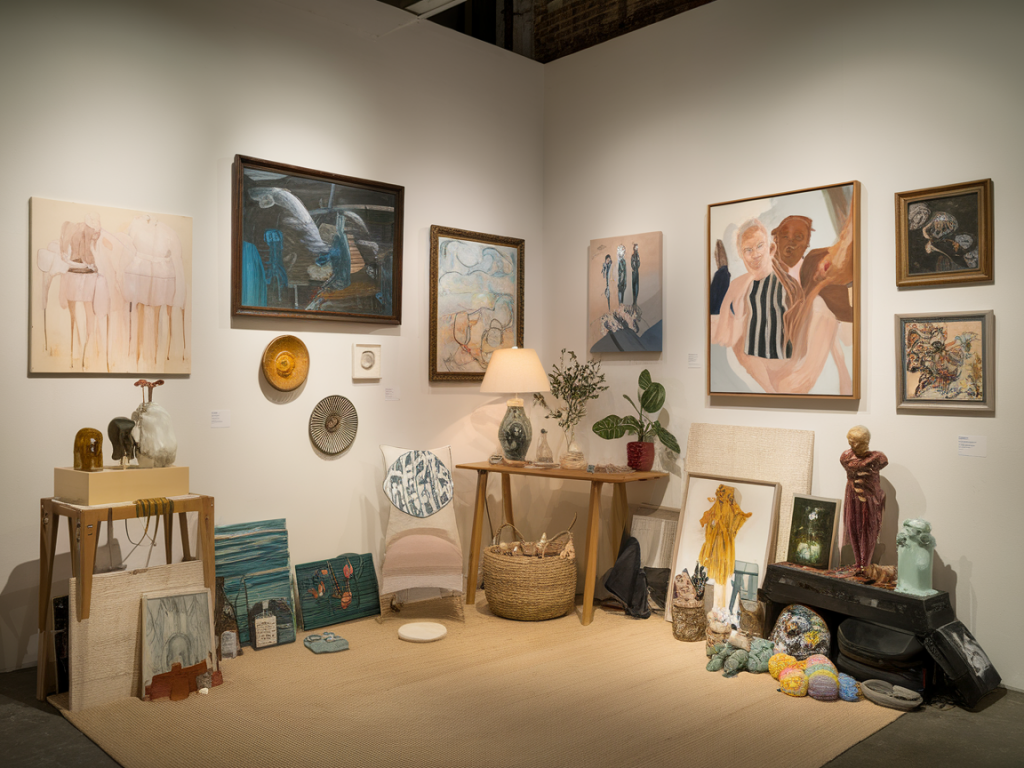
Presentation is everything, even on a budget. A clean, consistent hanging system makes work feel professional. Consider:
- Floating on painted MDF or archival foamboard instead of expensive framing.
- Using binder clips or bulldog clips for unframed works — painted in a single colour to look intentional.
- DIY box frames from reclaimed wood or inexpensive frames painted uniform colours. I’ve upcycled IKEA Ribba frames with a bit of filler and spray paint for a cohesive look.
For fragile works or paper, use Japanese paper hinges and conservation tape. If you’re unsure, ask a local framer for a single consult — paying for expert advice once can save money and risk later.
Lighting and installation planning
Lighting transforms a show and doesn’t need to break the bank. If the venue has built-in track lighting, plan your hang around it. If not, affordable clamp spotlights and LED panels can be positioned strategically.
- Test lights on works in your studio before the install day.
- Use gels or warm bulbs for paintings, cooler light for works on paper.
- Create a hang plan (sketch or digital mock-up) with exact wall dimensions and picture heights — this saves time and nails on the wall.
I always tape outlines of frame sizes to the wall and live with them for a day to check sightlines before fixing anything permanently.
Writing your artist statement and labels
Write short, accessible labels for each piece and a concise artist statement that explains the concept without over-explaining. Practical tips:
- Keep labels to one or two sentences of context plus medium and size.
- Lead with the idea — not the process. People respond to clarity.
- Have a colleague or friend read your statement: if they can’t summarise it in a sentence, simplify it.
For print, use A4 or A5 double-sided zines as handouts instead of an expensive catalogue. A one-page PDF that visitors can download from a QR code is both cheaper and eco-friendly.
Promotion that won’t cost much
Use what you already have: contacts, social channels and local networks. My go-to mix for low-cost promotion:
- Email a short, personalised press release to local press and art blogs (include images and a short artist bio).
- Create a consistent Instagram grid and Stories countdown. Use Reels to show quick studio-to-gallery transitions.
- Make a simple event page on Facebook and Eventbrite (free) and ask friends to share.
- Make a high-quality postcard (print 50–100) to hand out locally — cafés, shops and at other events.
If you have a modest budget, invest in one promoted post on Instagram targeted to your city and art-interested audiences — it’s cheaper than it sounds and can bring real footfall.
Installation day: workflow and helpers
Plan the day and recruit two helpers if possible. Bring a kit: measuring tape, laser level or spirit level, hammer, nails, picture hanging wire, pliers, sticky pads, cleaning cloth, and spare labels. My installation routine:
- Lay work on the floor and group by sequence.
- Mark heights on the wall and tape outlines.
- Hang centrepieces first, then fill outwards.
- Photograph the installed show for promotion (phone on tripod + small LED panel works well).
Leave time for adjustments and a walkthrough with the venue rep to ensure security and closing times are clear.
Opening night — low-cost hospitality and engagement
You don’t need catering to make an opening feel warm. I favour a simple drinks table, a sign-up sheet for my mailing list, and a short artist talk or guided walk-around timed 20–30 minutes after doors open. Encourage visitors to take photos and use a show hashtag.
Track sales and enquiries with a notebook or simple spreadsheet — note names, contacts, potential commissions and follow-ups. This small admin pays dividends after the show.