I take my mixed-media practice to festivals and outdoor events a lot — small commissions, quick commissions, live painting, or just sketching between talks. Over the years I’ve refined a kit that is compact, resilient and, crucially, forgiving of rain, mud, coffee spills and the odd bumpy ride on public transport. Below I’ll walk you through exactly what I pack, how I pack it, and the small habits that keep your materials usable when everything else is a bit chaotic.
My guiding principles
Before the gear list: a few rules I always follow when building a festival-ready kit.
Protect first: waterproofing and containment come before prettiness. A leak-proof bag saved me from ruined watercolours more than once.Limit complexity: choose multipurpose tools — fewer items reduce the chance of damage or losing something mid-event.Modular packing: separate wet from dry, consumables from tools, and fragile items from heavy ones so a single spill or squash doesn’t ruin everything.Plan for cleanup: include wipes, a microfibre cloth, and a small plastic bag for wet waste.Essential containers and cases
The containers you choose are the backbone of a resilient kit. My favourites:
Small dry bag (5–10L): a roll-top dry bag (or a lightweight waterproof backpack cover) keeps the entire kit safe if rain catches you. Sea-to-Summit and Ortlieb make reliable roll-top pouches.Hard case for fragile supplies: I use a small Pelican-style case for fragile pans, glass vials, or a tiny palette. It’s overkill until you spill a thermos on your kit — then you’ll be grateful.Zip pouches by material: one for dry drawing tools, one for wet tools (brushes, palette), and one for miscellany (clips, thread, spare batteries).Tackle box or small artist organiser: these are brilliant for tiny bottles, ink vials, and tubes. I like transparent trays so you can see contents quickly.Paper and supports
Paper selection matters more than people realise at festivals — damp air, uneven surfaces, and spontaneous rain require sturdy supports.
Small sketchbook (A5–A4): I favour 200–300gsm mixed-media paper or Strathmore Mixed Media pads. Stillman & Birn Beta or Gamma are great for paintings with a mix of wet and dry media.Single sheets in a waterproof folder: keep a few primed paper sheets in a plastic folder or a thin metal clipboard with a rubber band. The board gives you something stable to work on when surfaces are cramped.Pre-primed panels (optional): for quick demos I use small 8x10 gessoed panels packed in a rigid sleeve so they don’t bend when wet.Paints, inks and adhesives
Choose versions that are easy to control, refill, and contain.
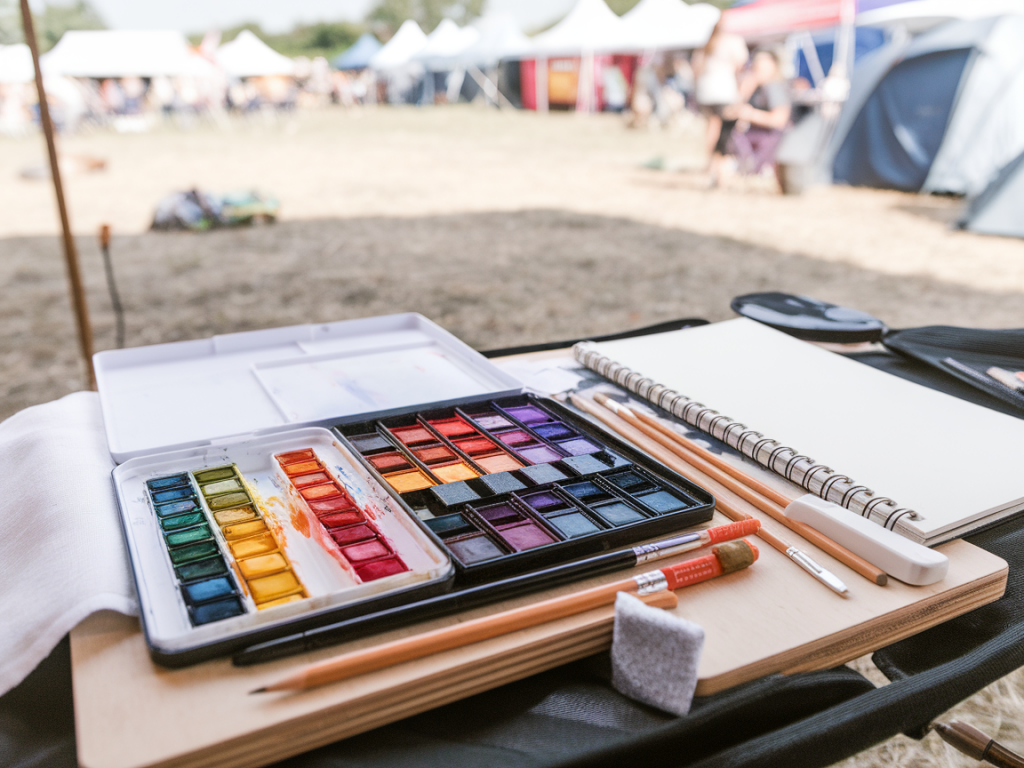
Watercolour pans or half-pans: Winsor & Newton, Schmincke or Sakura Koi — pans are compact and far less spill-prone than tubes. Keep them in a shallow palette with a lid.Gouache or acrylic in a few tubes: a small selection of primary colours plus white is enough. Golden and Liquitex both offer small tubes that travel well.Ink vials with secure caps: I transfer favorite blacks and coloured inks into small Nalgene or plastic vials with screw tops. Label them clearly.Glue stick and PVA (small bottle): glue sticks are festival-friendly; a tiny bottle of PVA is useful for collage but keep it in the hard case to prevent leaks.Brushes, pens and multipurpose tools
Pick tools that work both for detailed work and quick covering of areas.
Water brushes: ideal for quick washes and travel. I carry one medium and one fine.Short-handled synthetic brushes: easier to keep in a closed pouch and don’t require an easel-length space. A 10mm flat and a 2–4 round are my minimum.Waterproof fineliners: Sakura Pigma Micron or Uni Pin for linework that won’t bleed under a wash.Brush pen: Pentel Pocket Brush or Tombow Fudenosuke for expressive marks.Palette knife: a small metal palette knife for impasto or collage glue application.Mixing and water containment
Spilling water is one of the most common disasters at outdoors events. I never carry loose cups of water.
Collapsible silicone cup with lid: you can close it between uses. Sea to Summit X-Cup or similar.Leakproof flask for clean water: a small 250–500ml Nalgene or Klean Kanteen with a secure lid. Use two caps if necessary — one for pouring, one for drinking.Palette: folding plastic palette with a snap lid — acts as both mixing surface and secure storage for wet paint.Waterproofing and emergency fixes
When you work outside it’s not a question of if but when something gets wet or sticky.
Zip-lock bags and heavy-duty freezer bags: use these for quick containment of wet brushes, unexpected rain over a painting, or to protect a sketchbook while you shelter.Silica gel sachets: pop a few in the case to reduce humidity on damp days.Gaffer tape and masking tape: gaffer secures your board to a table or bench, masking for temporary edges.Microfibre cloth and wet wipes: for quick cleanup and blotting washes.Packing layout (my daily kit)
How I arrange everything so I can find it mid-scramble.
Top pocket of backpack: wallet, phone, tickets, small sketchbook for immediate access.Middle compartment: hard case with pans and tiny vials, tackle box with inks and tubes.Front pouch: pens, pencils, water brushes in a pencil roll, tape, keys.Side pocket: water flask and collapsible cup.Outer clip or carabiner: roll-up rain cover or a small towel.Working under pressure: setup and workflow
At a festival you rarely get a roomy table. Here’s my condensed workflow so I stay productive and tidy.
Set a small footprint: clear a 30x40cm working area on a folding table or your lap board. Use a clipboard for support.Lay down a waterproof mat: a small plastic placemat stops paint from staining borrowed tables and keeps tools from slipping.Limit in-use items: only have out what you’ll use in the next 10–20 minutes. Put everything else back into the hard case or zip pouch.Work in stages: do linework first (pen), then washes, then finally acrylic/gouache highlights once earlier layers dry.Use lids as mixing wells: small screw-top lids are perfect for limited palette mixing and seal easily in a zip bag if you need to move.Checklist you can copy
| Bag & containers | Dry bag, hard case, 3 zip pouches, tackle box |
| Paper | Sketchbook (mixed-media), 3 single sheets in plastic folder, small board |
| Paints & inks | Watercolour pans, small gouache/acrylic tubes, ink vials |
| Tools | Water brushes (2), short-handled brushes, palette knife, water cup (collapsible) |
| Fixes & cleanup | Wipes, microfibre cloth, zip bags, tape, silica gel |
| Extras | Spare batteries, phone charger, small spray fixative, business cards |
Bring fewer colours and better paper than you think you need. My portable kit is built around the idea that constraints breed interesting decisions — when you can’t lay out a studio, you make stronger compositional choices and more decisive marks. Above all, protect the things you can’t easily replace (paper, favourite brushes, original work) — the rest can be replaced or improvised on the day.