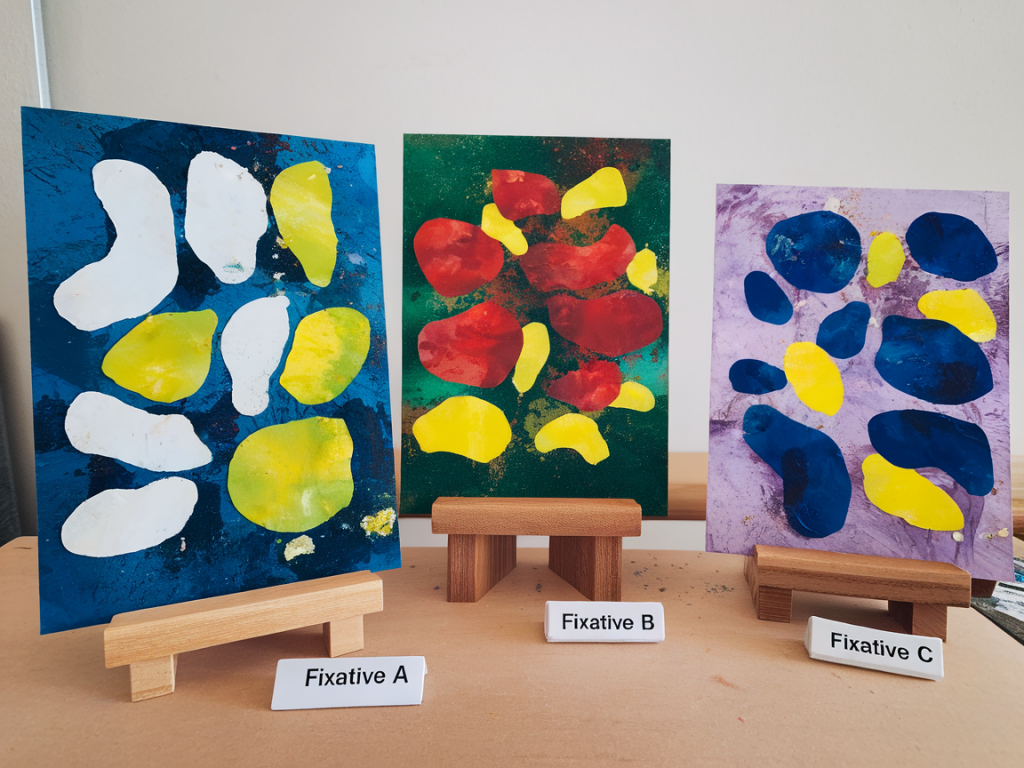
I tested three lower-VOC, water-based varnish/fixative options that are easy to find in art shops: Liquitex Solvent-Free Spray Varnish (matte), Winsor & Newton Artisan Varnish (gloss, brush-on), and Golden Polymer Varnish (satin, brush-on). My aim was practical: how do they perform on mixed-media pieces where gouache, acrylic, ink and collage meet; do they change colour or sheen; how do they smell in the studio; and how robust do they seem after simulated wear?
Why I tested these products
Many mixed-media makers want protection without a cloud of fumes or a dramatic shift in surface tone. Aerosol sprays have traditionally been solvent-heavy, and brush-on acrylic varnishes are sometimes sticky or glossy in ways that flatten delicate layers. I wanted to compare a solvent-free spray with two water-based brush-on varnishes to see trade-offs in colour shift, longevity (surface protection), and odour — three things that matter in a small studio and for finished work sold or exhibited.
My test method
I made a single mixed-media testboard (300gsm mixed-media paper mounted on a panel) divided into three vertical panels. Each panel contained:
I took high-resolution photos under consistent daylight-balanced lighting before applying any fixative. I applied each product according to manufacturer instructions: two thin coats for sprays with recommended drying time; two thin coats with a soft flat brush for brush-on varnishes, allowing full cure time between coats. After full cure (7 days at studio temperature ~19–21°C), I evaluated:
Results at a glance
| Product | Colour shift | Sheen | Smell (0–10) | Surface robustness | Best for |
|---|---|---|---|---|---|
| Liquitex Solvent-Free Spray (Matte) | Minimal—subtle darkening in some gouache washes | Even matte, slightly deadens bright acrylics | 2 (very mild aerosol scent) | Good—resists light abrasion, no tackiness | Mixed-media where aerosol convenience is desired |
| Winsor & Newton Artisan Varnish (Gloss, brush-on) | Small increase in saturation and depth (gloss boost) | High gloss, very even | 3 (slight water-based varnish smell) | Very good—forms a hard surface; slight fingerprinting if heavy | Works well for saturated colour pieces, gallery-facing finishes |
| Golden Polymer Varnish (Satin, brush-on) | Very subtle, balanced | Satin with pleasant soft reflection | 2 (barely noticeable) | Excellent—flexible and durable, resists abrasion | Everyday mixed-media, works on collage edges |
Detailed observations
Liquitex Solvent-Free Spray
The spray went on smoothly and dried fast. I liked that it didn’t leave the slightly granular feel some sprays do. Colour-wise, the biggest effect was a small darkening of some of the more dilute gouache washes — not a hue change, but greater saturation. For bright acrylic marks the matte finish slightly reduced “pop”, which may or may not be desirable depending on the piece.
Odour was low — a faint aerosol note that dissipated within 30–60 minutes in my ventilated room. The spray handled collage edges reasonably well; it didn’t lift tissue or printed paper. In the rub test it held up well; I couldn’t displace ink lines with cloth. Overall it felt like the best compromise if you prefer a spray application without heavy solvents.
Winsor & Newton Artisan Varnish (Brush-on, Gloss)
Applied with a soft synthetic brush, the gloss finish immediately deepened colours and brought out texture. That gloss brightness is noticeable — the gouache looked richer, inks popped. If you like saturated, jewel-like surfaces this varnish delivers.
It had a slightly stronger smell than the other two but still mild compared to solvent-based varnishes. The main downside I noticed was potential fingerprinting if you handle the piece before full cure (I used gloves). The surface after curing felt the hardest of the three — fingernail scratches were more difficult to make. However, that hard surface is slightly less forgiving over highly textured collage; you can see minor leveling over extreme peaks.
Golden Polymer Varnish (Brush-on, Satin)
This is the most neutral-feeling finish. Colour shift was minimal; the satin sheen added depth without overt gloss. The brush application was easy — the varnish self-levelled and didn’t drag delicate ink lines. It was the least likely to highlight texture flattening compared with the high gloss varnish and kept edges of collage tidy.
Smell was negligible. It resisted abrasion very well and felt flexible rather than glassy. That flexibility is an asset for works on paper or small panels that may experience small dimensional changes.
How I interpreted longevity and colour stability
None of these water-based, lower-VOC options are a guarantee against long-term yellowing or light damage — that depends on pigments, paper quality and framing. What I found encouraging was that after seven days of bright window exposure the relative behaviour stayed consistent: the Winsor & Newton gloss retained its depth (but also its reflectivity), Liquitex matte remained stable though slightly subduing washes, and Golden sat comfortably between the two.
For archival thinking, layer protection is still important: if you have unfixed charcoal or pastel, a true spray fixative targeted for dry media is still necessary before varnishing. These varnishes are best as final protective layers over dry, stable mixed-media work.
Practical tips for artists
If you’d like, I can prepare printable swatches (high-res photos) of the three finishes on different media from my testboard so you can compare sheen and colour shifts in your reference material — or run the same tests on a specific paper/paint combo you use in your practice.