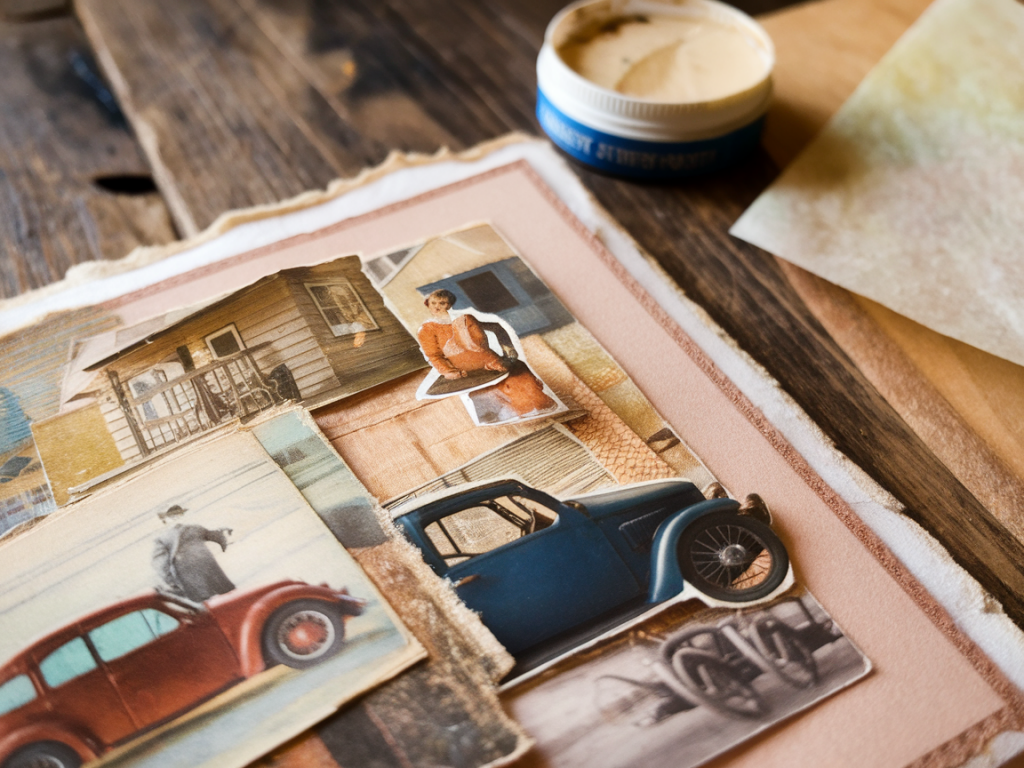
I often find that the smallest edges—torn paper, fragile ephemera, feathered collage bits—are the ones that make or break a piece. Over time, delicate edges can lift, catch, or disintegrate, and that can be devastating after hours of careful layering. I rely on two simple, conservation-friendly allies to stabilise those edges: archival (Japanese/mulberry) tissue and wheat starch paste. Together they make repairs that are strong yet reversible, flexible, and visually discreet. Below I share how I prepare the paste, choose the tissue, and the hands-on steps I use in the studio, along with troubleshooting tips from things I’ve learned the hard way.
Why wheat starch paste and archival tissue?
Wheat starch paste is a long-established adhesive in conservation. It’s reversible with water, ages well when made correctly, and remains flexible. Combined with a thin archival tissue (Japanese papers like kozo or tengujo, or mulberry paper), it stabilises edges without creating bulky joins or unsightly glue ridges. Unlike PVA glues, which can yellow, become brittle or are difficult to reverse, wheat starch paste is sympathetic to paper and to collage work where future conservation may be needed.
Materials I use
- Wheat starch powder made for bookbinding/conservation (not common kitchen wheat flour). Brands vary by country—look for "wheat starch for conservation" or buy from a conservation supplier like Talas or Creartec if available. In a pinch, bookbinders’ wheat starch is preferable to plain flour.
- Distilled water—minimises impurities and mould risk.
- Archival tissue such as Japanese kozo (thin, strong), tengujo (very thin), or mulberry tissue. I like Tengujo 12–30 gsm for extremely fine edges, and stronger kozo for slightly heavier support.
- Soft brush (size 2–6), a small hake brush or watercolor brush.
- Bone folder or microspatula
- Greaseproof/silicone release paper for drying and preventing sticking.
- Blotting paper or clean kitchen paper for drying and pressure distribution.
- Weights (books, wooden boards) or a dry point press if you have one.
- Small spray bottle for humidifying if you need to relax cockled pieces gently.
Recipe: wheat starch paste (basic and reliable)
This is the simple cook-and-strain method I use for studio repairs. Make small batches fresh and store in the fridge for a few days if needed. Always label with date.
- Measure by weight: 1 part wheat starch powder to 4–5 parts distilled water (for example, 20 g starch + 100 g water).
- Make a slurry: mix the dry starch with a little cold distilled water (about 1/4 of the total) to form a lump-free paste.
- Heat the rest of the water to near-boil in a saucepan. Remove from heat and pour a little hot water into the slurry while stirring, then return to the pan and gently heat, stirring constantly. The mixture will go cloudy then clear and thicken—stop heating once it becomes translucent and slightly glossy. Simmer very briefly for 1–2 minutes; do not overcook.
- Remove from heat, whisk smooth, and strain through a fine sieve or silk straining bag to remove any particles.
- Cool before use. The paste should be tacky but not gluey; adjust by adding a little water if too stiff.
Preparing the collage and tissue
Clean, flat working surfaces are essential. If edge pieces are curled or folded, I first gently humidify with a fine mist (from a distance) and press flat between blotters under a weight until mostly dry—but not bone-dry; a little moisture helps adhesion. Test a tiny discreet area first to check for reactions.
Cut or tear the archival tissue to size so it overlaps the fragile edge by a few millimetres—enough to give support but not so much that the tissue becomes a visible band. For extremely fine feathered edges I sometimes sandwich a tissue strip under and over the edge (a tiny hinge) for maximum support.
Application technique: minimal, neat, reversible
- Place the artwork face up on your work surface. Have a sheet of release paper under the area in case adhesive squeezes out.
- Apply a thin layer of paste to the tissue, not the artwork, using a soft brush. Work from the centre of the tissue toward the edges to avoid air pockets. The tissue should be tacky but not sodden—excess moisture will cockle the support paper.
- Align the tissue over the fragile edge and gently lay it down. Use a small soft brush or microspatula to smooth it into place, working outward from the join.
- If you're hinging (tissue under and over), paste the under strip first, position the edge, then paste and lay the overlay strip carefully.
- Remove any squeeze-out immediately with a lightly damp cotton swab—blot, don’t rub.
- Cover with a non-stick release sheet and blotting paper, then a flat board and weights. Leave to dry flat for several hours or overnight. If you need a very flat join, I use a low-pressure press or sandwich between boards with glassine to avoid texture transfer.
Finishing and cosmetic considerations
Once dry, the tissue should be integrated but still discernible on close inspection—this is desirable in conservation-minded work. If the tissue is visually too bright or white against your paper, you can gently tone it with a very diluted wash of watercolor or a light wash of acrylic (test first). Be cautious: any tinting should be subtle and reversible where possible.
Common problems and troubleshooting
- Cockling/wrinkling: caused by too much water. Use less paste, thin the paste more, or dry under increased weight. For already-cockled areas, humidify lightly and re-press.
- White residue (bloom): sometimes paste can leave a powdery haze if over-applied. Rehydrate lightly and blot, or very gently brush away with a soft dry brush once fully dry.
- Stiff join: if the tissue feels too rigid, the paste might be too concentrated or the tissue too heavy. Use a thinner paste or choose a lighter tissue next time.
- Adhesive showing through thin paper: paste may show as a tonal change. Test adhesive concentration on scrap to match translucency.
Alternatives and when not to use wheat starch
For non-paper elements (plastics, metal trims, some painted surfaces), wheat starch is not appropriate. Methylcellulose (e.g., Methocel A4M) is another reversible adhesive I use for certain delicate detachments and surface consolidations because it dries more transparent and stays flexible. PVA or synthetic adhesives are tempting for speed but are permanent and can cause long-term problems; I avoid them on archival pieces unless there’s a clear reason and documentation.
Care and documentation
Label any repair discreetly on the verso with date and materials used—this is invaluable for future conservators or for your own records. Store works flat, away from humidity extremes and direct sunlight. If you routinely stabilise family archives or highly valuable ephemera, consider consulting a paper conservator for complex issues.
Studio tips from practice
- I always work with a handful of tissue types at the ready—having a variety of weights and colours saves time and keeps the join discreet.
- Make a small sample card with different paste dilutions and tissue types. It’s the quickest way to learn how a tissue will look once dried.
- Keep batches small and fresh. Old paste can ferment or develop a smell and should be discarded.
- When in doubt, less is more. A whisper of support often outperforms heavy-handed repairs.
Stabilising delicate collage edges is a gentle, patient practice. The right materials, a light touch and a little testing will protect your layered work without erasing the fragile character that drew you to those edges in the first place.