When I started moving my easel between rooms, studios, and occasional workshop spaces, I learned very quickly that a portable easel can be a blessing or a constant irritation. In a room with narrow doorways and uneven floors, I do not care much about a glossy finish or a dramatic silhouette. I care about whether I can carry it through a tight gap without scraping paint from the wall, whether it stands steady on a floor that slopes slightly toward one corner, and whether I can set it up without feeling as if I need a second pair of hands.
That practical reality changes what matters most. A portable easel is not simply about weight or foldability. It is about balance, footprint, adjustability, and the way it behaves in a real room with awkward architecture. I have used easels that looked elegant in a shop but became frustrating once I tried to open their legs on a floor that was never entirely level. I have also used compact designs that seemed modest at first glance, yet proved reliable because they were easy to manoeuvre and stable where it counted.
Size and footprint matter more than appearance
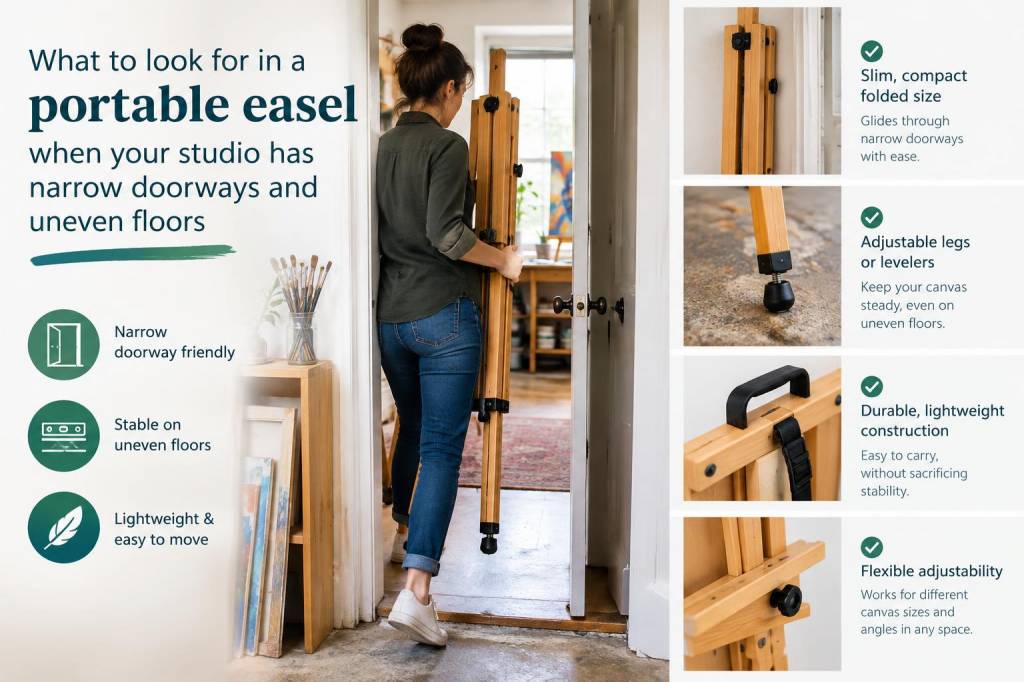
In a studio with narrow doorways, overall width is one of the first things I check. Some portable easels are technically foldable, but still feel bulky when folded because of protruding knobs, wide leg angles, or awkward crossbars. I prefer a design that folds into a slim profile and can pass through a doorway without me having to tilt it at an uncomfortable angle. If I need to turn sideways and carefully inch it through every entrance, it stops feeling portable.
I also pay attention to the footprint once it is open. A broad stance can help stability, but it can also become a problem in a cramped room. I want enough support to hold a large canvas, yet not so much spread that I cannot move around it. For me, a smart portable easel gives me a stable working position without swallowing the entire room. That balance is especially important if I am sharing space with furniture, drying racks, or storage shelves.
If you work in a room with limited access, measure more than you think you need to. Measure the doorway, yes, but also measure the turning space just inside it. A compact easel may still catch on a handle, a wall corner, or a radiator. I have found that a few extra centimetres can make the difference between easy movement and daily frustration.
Weight can help or hinder depending on use
People often assume lighter is always better, but I do not think that is true in every case. A very light easel is easier to move through narrow passages, carry upstairs, or shift around when cleaning. Yet if it is too light, it may feel twitchy on uneven floors, especially when supporting a larger surface or when I am working with firmer brush pressure. I want a portable easel that feels manageable in my hands but still grounded once it is in place.
Materials affect this greatly. Aluminium easels are often easier to carry and less tiring to move frequently. Wood can feel warmer and more traditional, and sometimes a little more substantial under the hands, but it may be heavier. I have used both, and my preference usually depends on the space. If I know I will be moving the easel daily through tight doorways, I lean toward lighter construction. If it will stay in one room for long stretches, I may accept extra weight in exchange for a more solid stance.
It is also worth considering how the weight is distributed. An easel can be light yet awkward if its centre of gravity feels wrong when folded or carried. A good portable design feels balanced, with no sudden sway that makes me worry about dropping it against a wall or floor.
Uneven floors call for real adjustability
Uneven flooring is where many easels reveal their weaknesses. A small tilt in the floor can cause a wobble that becomes distracting during painting, drawing, or glazing. I once worked in a room where one corner dipped just enough that every brushstroke felt like a tiny negotiation. Since then, I have become very alert to leg adjustment and base design.
The best portable easel for an uneven floor is one with independently adjustable legs or a reliable central support system that can compensate for differences in height. If the legs can lock at different lengths, I can level the easel without stacking folded paper under one side or pressing a book beneath a foot. Temporary fixes like that can work for a while, but they are never as dependable as proper adjustment.
I also look for rubber or non-slip feet. They are not glamorous, yet they make a real difference. On old wooden floors, tile, or slightly sloping surfaces, those feet help keep the easel in place while protecting the room. If I am working in a rented or shared studio, I especially appreciate anything that avoids scratches and reduces noise when I shift the stand.
Some artists ignore floor issues until they start using a larger canvas, but I think uneven ground affects everything from posture to concentration. If the easel feels unstable, I change how I stand, and then my shoulders tense. Over a long session, that matters. A well-adjusted easel should help me forget about the room and focus on the work.
Clamping, trays, and support bars deserve attention
Portable easels vary a great deal in how they hold a canvas. Some have simple ledges, others use clamps or adjustable trays, and some combine both. For me, the important question is whether the support feels secure without being fiddly. In a tight studio, I do not want to spend extra time wrestling with small parts every time I change size or format.
A lower tray that slides easily and locks firmly can be very useful, especially if I work across a range of canvas heights. I like a mechanism that moves with intention rather than one that slips when I least expect it. If I am using panels, paper boards, or stretched canvas of different thicknesses, I want a support system that accommodates all of them without constant reconfiguration.
Clamps are useful when I need extra security, but I inspect their reach carefully. Some clamps are placed in ways that make loading a canvas awkward in a narrow room, particularly if I have little space to step back and align the work. A good portable easel lets me place a panel quickly and remove it just as easily, without needing to twist my body into a strange shape.
Foldability matters only if it is genuinely easy
I have seen easels described as portable when, in practice, folding them felt like solving a small mechanical puzzle. If I need instructions every time I pack it away, I stop using it with pleasure. A truly portable easel should fold in a way that feels intuitive. Ideally, it should close smoothly, lock securely, and reopen without repeated trial and error.
This is especially important in a studio with narrow doorways, where I may need to move the easel frequently rather than store it in one permanent position. An awkward folding mechanism becomes a daily annoyance. I prefer clear, sturdy hardware with a small number of moving parts, because simplicity often means fewer things to fail later.
Carry handles or integrated grips can also be more helpful than they first appear. If I am moving an easel through a corridor, across a landing, or into another room, a sensible grip makes the entire process safer and less clumsy. It is one of those details I notice most after I have used a design that lacks it.
What I inspect before I buy
Whenever I look at a portable easel for a difficult space, I make myself examine a few practical points before I commit. These details save me from regret later:
- Folded width so I know it will pass through narrow doors
- Open footprint so I can judge whether it will crowd my workspace
- Independent leg adjustment for uneven floors
- Non-slip feet for grip and floor protection
- Secure canvas support for different sizes and thicknesses
- Simple folding action so packing away does not become a chore
- Balanced carry weight so transport feels safe and manageable
- Hardware quality so moving parts do not loosen quickly
I also like to imagine the everyday use case, not just the ideal one. Will I need to move it while carrying brushes, paint, or a wet panel? Will I want to open it one-handed? Can I adjust it without bending awkwardly? These questions sound minor, but they shape whether a portable easel feels genuinely helpful or merely convenient in theory.
What has worked for me in real studios
In my own experience, I tend to favour easels that sit somewhere between a tripod and a studio easel. I want something light enough to move through a narrow doorway, yet sturdy enough for serious work. I have used compact aluminium models for quick studies and smaller paintings, and I have appreciated their speed when working in temporary spaces. I have also used wooden folding easels that felt steadier for longer sessions, though they demanded more care when moving them around.
For uneven floors, I have found that stronger adjustment mechanisms matter more than brand reputation alone. A well-built lesser-known easel can outperform a prettier, more expensive one if its feet and leg locks are actually dependable. I also value a finish that cleans easily, because portable equipment inevitably gets knocked, brushed, and marked during transport.
One detail I now never overlook is the sound an easel makes when I set it down. A noisy clatter often suggests thin parts or loose fittings, while a more controlled, solid touch usually gives me more confidence. That may sound subjective, but in practice it often tells me something about the overall build.
| Feature | Why it matters in a narrow or uneven studio | What I prefer |
|---|---|---|
| Folded width | Fits through tight doorways | Slender profile with no awkward protrusions |
| Leg adjustment | Compensates for floor variation | Independent, secure locking legs |
| Foot design | Improves grip and protects floors | Rubber or non-slip feet |
| Weight | Affects transport and stability | Light enough to move, solid enough to stay steady |
| Support system | Holds varied canvas sizes safely | Adjustable tray or secure clamps |
| Folding mechanism | Makes daily use easier | Simple, reliable, quick to operate |
When I think about a portable easel now, I think less about whether it is fashionable and more about whether it respects the room I have. A studio with narrow doorways and uneven floors asks for equipment that is forgiving, adaptable, and quietly dependable. That is what I look for every time I choose one, and it is what I will keep looking for in every new studio space I use.